
Parking Lot Maintenance Costs vs Revenue: What to Expect
Realistic maintenance costs for parking lots — sealcoating, striping, lighting, snow — and how they compare against monthly and transient parking revenue.
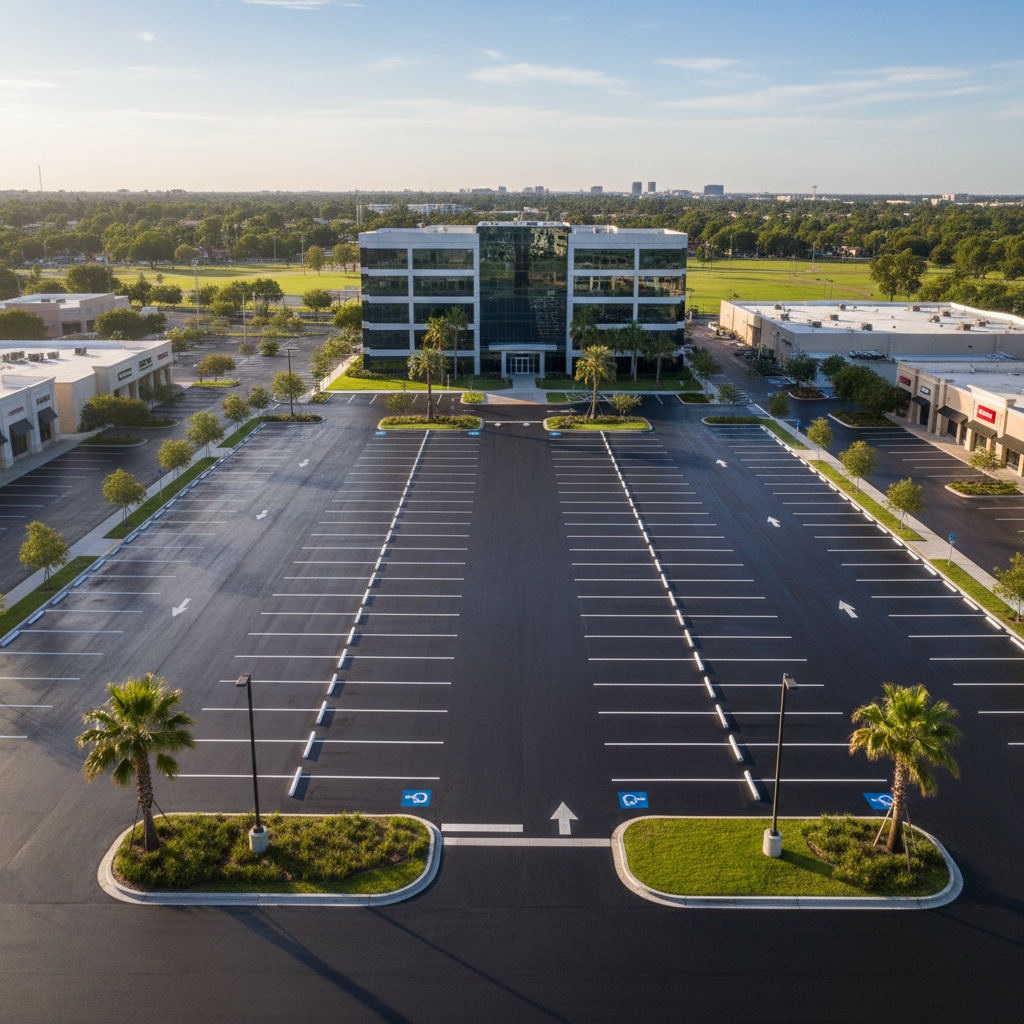
Understanding the true relationship between maintaining a parking asset and the revenue it produces is essential for owners, investors, and property managers who need accurate cash flow and valuation models. Maintenance choices directly affect operating costs, occupancy, and long-term pavement condition — and those outcomes feed into a parking lot's valuation.
This post breaks down the primary line items in parking lot maintenance cost, gives realistic cost and revenue examples, and shows how those numbers affect parking lot net operating income (parking NOI). Use the figures here to stress-test your assumptions or run a quick analysis with the free What Is My Parking Worth calculator to see how maintenance scenarios change value.
What comprises parking lot maintenance cost?
Parking lot maintenance cost covers recurring operational activities and periodic capital repairs. Operational items recur monthly or seasonally: cleaning, trash removal, line striping, lighting electricity, security, routine pothole patching, and snow removal where applicable.
Capital or preservation costs occur less often but are larger: sealcoating, major asphalt repairs, resurfacing, drainage upgrades, and ADA compliance upgrades. Distinguishing between operating and capital expenses matters because accounting and valuation treat them differently.
Common parking lot expenses and typical ranges
Line items and approximate ranges help build realistic budgets. These are estimates; your local climate, material prices, and contract structures will change the numbers.
- Regular cleaning and sweeping: $0.05–$0.20 per square foot/year (estimate).
- Striping and stenciling: $0.30–$1.00 per linear foot, or $0.50–$2.00 per stall annually depending on frequency (estimate).
- Lighting (electricity & maintenance): $15–$45 per fixture/year for electricity and $10–$40/fixture for annual maintenance (estimate).
- Snow removal: $25–$120 per plow pass for small lots; contract-season caps are common (estimate).
- Pothole patching & localized repairs: $200–$1,500 per repair depending on size (estimate).
- Sealcoating cost: $0.08–$0.25 per square foot (estimate) — this is covered in the next section in detail.
Sealcoating cost and when to schedule it
Sealcoating cost is typically measured per square foot. For a 20,000 sq ft lot, at $0.15/sq ft (estimate), the sealcoating line item would be roughly $3,000 (estimate). Timing matters: sealcoating every 3–5 years maximizes pavement life and delays expensive resurfacing.
Example: If you operate a 120-space surface lot (estimate), and you schedule sealcoating every 4 years, spread that cost into annual budgets. Assume the lot footprint is 24,000 sq ft and sealcoating at $0.15/sq ft (estimate): $3,600 per event → $900/year (estimate).
Sealcoating also reduces annual repair frequency. A proactive strategy where sealcoating is applied on schedule often lowers cumulative repair costs over a 10–15 year horizon compared to deferred maintenance.
Routine maintenance vs capital expenditures: accounting and valuation impact
From a practical standpoint, parking lot expenses split into operating expenses and capital expenditures. Routine maintenance flows through net operating income immediately; capital expenditures are typically capitalized and depreciated. For investors focused on parking lot net operating income, operating expenses drive the short-term NOI while capital projects affect long-term cashflow projections and resale value.
Example: A property generates $10,200/month in gross parking revenue (estimate) — derived from $85/month × 120 spaces = $10,200/month (estimate). If recurring operating costs (cleaning, lighting, management, routine repairs) total $2,500/month (estimate), the monthly operating contribution before capital expenditures is $7,700/month (estimate). A one-time resurfacing of $60,000 (estimate) should be treated separately in valuation models as a capital project rather than a recurring operating expense.
How to calculate parking lot net operating income and parking NOI
Parking NOI is calculated the same way as for other commercial assets: Gross Parking Revenue minus Vacancy and Credit Losses minus Operating Expenses = Parking NOI. For precision, segregate maintenance that is recurring (operating) from capital work.
Example annual calculation (estimates):
- Gross parking revenue: $85/month × 120 spaces × 12 months = $122,400/year (estimate).
- Vacancy/credit loss (5%): $6,120/year (estimate).
- Net effective revenue: $116,280/year (estimate).
- Operating expenses (cleaning, lighting, routine repairs, snow removal): $36,000/year (estimate).
- Parking NOI: $116,280 − $36,000 = $80,280/year (estimate).
Cap rate and valuation use that parking NOI. If the market cap rate for similar parking assets is 6.5%, estimated asset value = $80,280 / 0.065 = $1,234,308 (estimate). Running sensitivity analyses where sealcoating schedules, energy-efficient lighting upgrades, or higher repair rates are tested will show how fragile or robust that NOI is — and you can do that quickly with the What Is My Parking Worth calculator.
Maintenance decisions that materially change parking NOI
Some maintenance choices have outsized impacts on parking lot expenses and therefore parking NOI. Examples include lighting technology, snow removal contracts, and pavement preservation strategy. Upgrading to LED lighting reduces annual electricity and maintenance costs but requires upfront capital; the NOI benefit depends on payback period and whether you capitalize the upgrade.
Deferred pavement maintenance can depress NOI in two ways: increased operating repairs and higher vacancy or reduced utilization from poor surface condition and aesthetics. A well-timed sealcoating program usually offers the best ROI among pavement strategies because sealcoating cost is relatively low compared to resurfacing and it extends the life of existing asphalt.
Practical optimization strategies to reduce parking lot expenses
Owners and managers should prioritize interventions that lower recurring costs without undermining service. Practical strategies include bulk contracting for routine services, demand-based snow removal with trigger thresholds, and preventive sealcoating schedules tied to condition assessments. Documented maintenance reduces surprises in budgeting and valuation models.
Use tools to model the trade-offs. For instance, compare a base case against an optimized case where sealcoating frequency changes from 6 years to 4 years and LED lighting is installed. The resulting change in operating expenses and capital timeline will show the net effect on parking NOI. If you prefer direct inputs, try the parking revenue calculator to model revenue-side sensitivity, and consult the Commercial Parking Lot Revenue Guide for revenue optimization tactics.
Maintenance, revenue, and value: linking to broader property strategy
Maintenance decisions for a parking lot rarely exist in isolation. Pavement condition affects tenant perceptions, curbside access, and even lease negotiations. For properties where parking generates a discrete revenue stream, demonstrating consistent investment in maintenance can justify higher rates and lower vacancy assumptions in underwriting.
When you’re preparing a sale or refinancing, be prepared to show maintenance records and a capital plan. Buyers will review historical parking lot expenses and project future capital needs. If you want to test how different expense and capital scenarios influence valuation, read our analysis on what drives parcel-level parking valuations in What Affects Parking Lot Value? A Property Owner's Guide, and run the numbers in the calculator to validate assumptions.
Final Thoughts
Parking lot maintenance cost is a predictable, controllable component of parking operations when you separate routine operating expenses from periodic capital work and schedule prevention appropriately. Small, regular investments like sealcoating and timely striping keep surface condition high, protect revenue, and limit surprise capital needs that compress parking NOI.
For investors and managers, the best practice is to test multiple scenarios: baseline operations, optimized maintenance, and deferred-maintenance cases. Those scenarios drive different NOI outcomes and, therefore, materially different valuations. Use condition assessments and conservative unit-cost estimates when projecting future expenses to avoid overstating short-term NOI.
To quantify how different maintenance plans affect your asset’s parking lot net operating income and overall value, run a scenario in the What Is My Parking Worth calculator today and validate your assumptions against market benchmarks.