
University and Campus Parking Revenue Opportunities
How colleges generate parking revenue from student permits, faculty passes, visitor parking, event parking, and unused capacity during breaks.
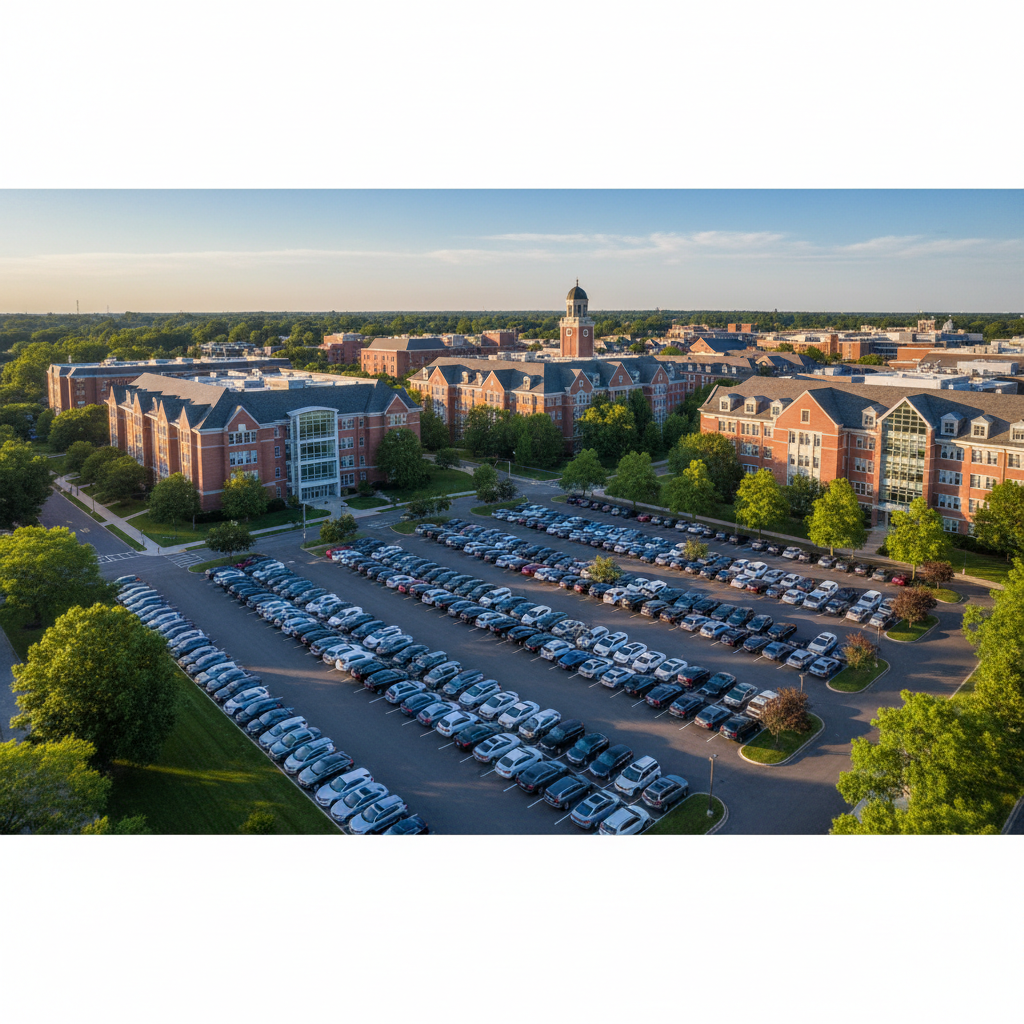
University parking assets are underpriced and under‑managed more often than owners realize. With predictable daily demand, seasonal peaks around term starts and game days, and captive audiences of students, staff, and visitors, campus parking presents repeatable revenue streams that respond well to relatively small operational changes.
This post lays out tactical, financially grounded opportunities for owners of a college parking lot, garage, or surface field — from permit pricing to event day capture — and shows how to quantify upside using industry benchmarks and calculators designed for parking assets.
Assessing university parking revenue potential
Start with utilization and segmentation: how many total stalls you own, what percentage is reserved for administration, what’s allocated to students, and how many are available for daily paid parking or event-day use. A simple occupancy baseline identifies immediate lift opportunities—if a lot averages 65% occupancy on weekdays but has a pool of 200 underused stalls, that’s revenue you can convert.
Quantify revenue scenarios with conservative assumptions. Example (estimate): a 120-space surface lot priced at $85/month for student permits would generate roughly $85/month × 120 spaces = $10,200/month (estimate) or about $122,400/year (estimate) before expenses. Running different scenarios — lower price with higher take-up, or tiered pricing for preferred stalls — clarifies which levers matter most for ROI.
For a quick system-level check you can use the internal valuation tool to test price, occupancy, and permit mix assumptions — try the What Is My Parking Worth calculator to model revenue and valuation uplift from simple changes to pricing or utilization.
Optimizing campus parking permits and permit pricing
Campus parking permits are the backbone of predictable campus cash flow. Rather than a one‑size‑fits‑all permit, create tiers: reserved premium stalls, standard permits, remote/overflow permits, and short‑term daily permit passes. This segmentation supports price differentiation and captures both students willing to pay for convenience and budget‑sensitive users who will accept a walk.
Use price elasticity testing. Example (estimate): increasing the standard permit from $75/month to $85/month with an expected 5% attrition across 200 holders yields ($85 − $75) × (200 × 0.95) ≈ $1,900/month incremental revenue (estimate). Conversely, introducing a $45/month overflow permit that attracts an additional 50 users would add $2,250/month (estimate). Testing small, visible changes limits backlash and provides data.
To project multiple pricing permutations at once, run scenarios through a parked‑asset model or a dedicated parking revenue tool. A purpose-built parking revenue calculator helps translate permit mixes into monthly and annual revenue while incorporating vacancy and turnover assumptions.
Designing student parking fees that balance access and revenue
Student parking fees are politically sensitive but financially potent. The key is transparency: communicate how revenue is reinvested (safety, lighting, shuttle service, ADA access) and offer options that align with students’ budgets. Consider semester or academic-year permits with prorated pricing for late registrants to increase uptake while reducing administrative overhead from daily passes.
Examples of fee structures that work on many campuses include:
- Flat monthly or semester permits for resident students.
- Low-cost commuter passes for off-campus students tied to shuttle access.
- Hourly or daily mobile pay for occasional visitors and faculty guests.
Quantify student fee changes against behavioral assumptions. Example (estimate): converting 300 occasional student daily users paying $3/day into a $45/month subscription yields $45 × 300 = $13,500/month (estimate) and reduces transaction costs and enforcement time.
Strategies to maximize income from a college parking lot
A college parking lot can be a steady cash generator if you apply active asset management: enforce rules consistently, convert underused areas into paid stalls, and lease reserved blocks to campus departments. If part of the lot sits empty during summer, a short‑term leasing program to local businesses or parking apps can maintain revenue year‑round.
Operational improvements that generate measurable uplift include:
- Converting overflow spaces to paid hourly parking during peak hours.
- Creating reserved blocks for campus contractors or pop-up vendors at higher daily rates.
- Introducing flexible staffing or automated gates to reduce labor expense and leakage.
For owners evaluating conversion options, the math often favors modest capital investment. Example (estimate): investing $35,000 in access control and signage for a 300-space lot that increases paid occupancy by 10% could add roughly 30 occupied spaces; at $80/month average permit that’s $80 × 30 = $2,400/month or ~30 months payback (estimate), not accounting for operational efficiencies.
Event day parking: extracting premium rates without alienating the campus
Event day parking is a high-margin opportunity if planned ahead. Sports, performances, and graduation generate concentrated demand; capture it through pre‑sale permits, tiered pricing, and shuttle combos. The key is capacity planning and clear communication with regular permit holders to avoid surprise displacement.
Price anchoring and pre-sale can double or triple standard daily rates on high-demand days. Example (estimate): a 500-space lot sold at $25/event (pre-sale) yields 500 × $25 = $12,500/event (estimate). With four major events per year, that’s $50,000 incremental revenue (estimate) before event-day operating costs. Dynamic pricing tied to inventory levels further maximizes revenue per stall.
Operational best practices for event-day monetization:
- Pre-sell and validate with QR codes to avoid cash handling.
- Offer premium closer stalls at higher prices and shuttle-based remote lots at a discount.
- Coordinate with campus security and transit to ensure smooth ingress/egress and protect brand reputation.
Operational and technology upgrades that drive revenue
Investments in technology often unlock disproportionate returns through reduced leakage, improved user experience, and better pricing control. Consider automated revenue control, mobile pay, permit management platforms, and license‑plate recognition for enforcement. These tools reduce staffing needs and enable real‑time pricing experiments.
Technology choices should be driven by unit economics. For example, mobile pay adoption can reduce lost revenue from cash handling and allow dynamic pricing; automated gates reduce tailgating and ad hoc free entry. Typical upgrades and likely impacts:
- Mobile payments and digital permits — faster transactions and higher capture of casual users.
- ANPR (license‑plate recognition) — streamlined enforcement and reduced administrative burden.
- Cloud-based permit management — automated renewals and tiered pricing capabilities.
If you’re exploring whether upgrades will move the needle for your site, compare scenarios in tools like the What Is My Parking Worth calculator and reference our operational playbook in the Commercial Parking Lot Revenue Guide for case studies and cost benchmarks.
Additional monetization channels and risk management
Beyond permits and event days, look for adjacent revenue streams: advertising on signage, EV charging fees, car charging subscription programs, and short-term leases for food trucks or storage on non-peak days. Each stream diversifies income and spreads fixed costs across activities.
Risk management is equally important. Address permit fraud, calibration of enforcement levels, liability insurance for events, and clear communication around changes to access. A small legal or PR issue during a high-profile event can erase months of revenue gains. Review contracts, post clear terms for permit holders, and ensure data privacy practices if you deploy ANPR.
For owners seeking tactical ideation on converting idle capacity into steady cash, our article on How To Monetize Unused Parking Spaces outlines practical short‑term programs that often integrate with longer-term permit strategies.
Final Thoughts
University and campus parking revenue is a function of strategy as much as location. Thoughtful permit design, disciplined enforcement, event-day pricing, and targeted technology investments convert otherwise static assets into predictable cash flow. Small changes to permit mix, pricing, or access control frequently produce measurable revenue uplift within months.
Start with data: measure current occupancy, run conservative price elasticity tests, and model scenarios to understand payback. Use scenario tools to compare permit pricing, event pricing, and tech upgrades side-by-side. If you want a quick, comparable valuation or to test multiple assumptions against your asset, use the integrated parking revenue calculator to see outcomes under different strategies.
Ready to quantify your lot or garage? Run your numbers now with the What Is My Parking Worth calculator and turn campus parking into a clearer, higher-yield asset.